Manufacturing Guide E-E-A-T Optimised AEO · GEO · LLM-SEO

Non Stick Set
( Kadhai · Tawa · Fry Pan )
Manufacture

Non-stick cookware manufacturing is a sophisticated industrial process transforming aluminium alloys, hard-anodised substrates, and food-grade PTFE or ceramic coatings into kitchen essentials — kadhai, tawa, and fry pan sets used by millions daily. From die-casting and pressing to multi-layer coating application and rigorous food-safety testing, this sector combines metallurgical precision with culinary science to serve homes, hotels, and global retail markets at scale.
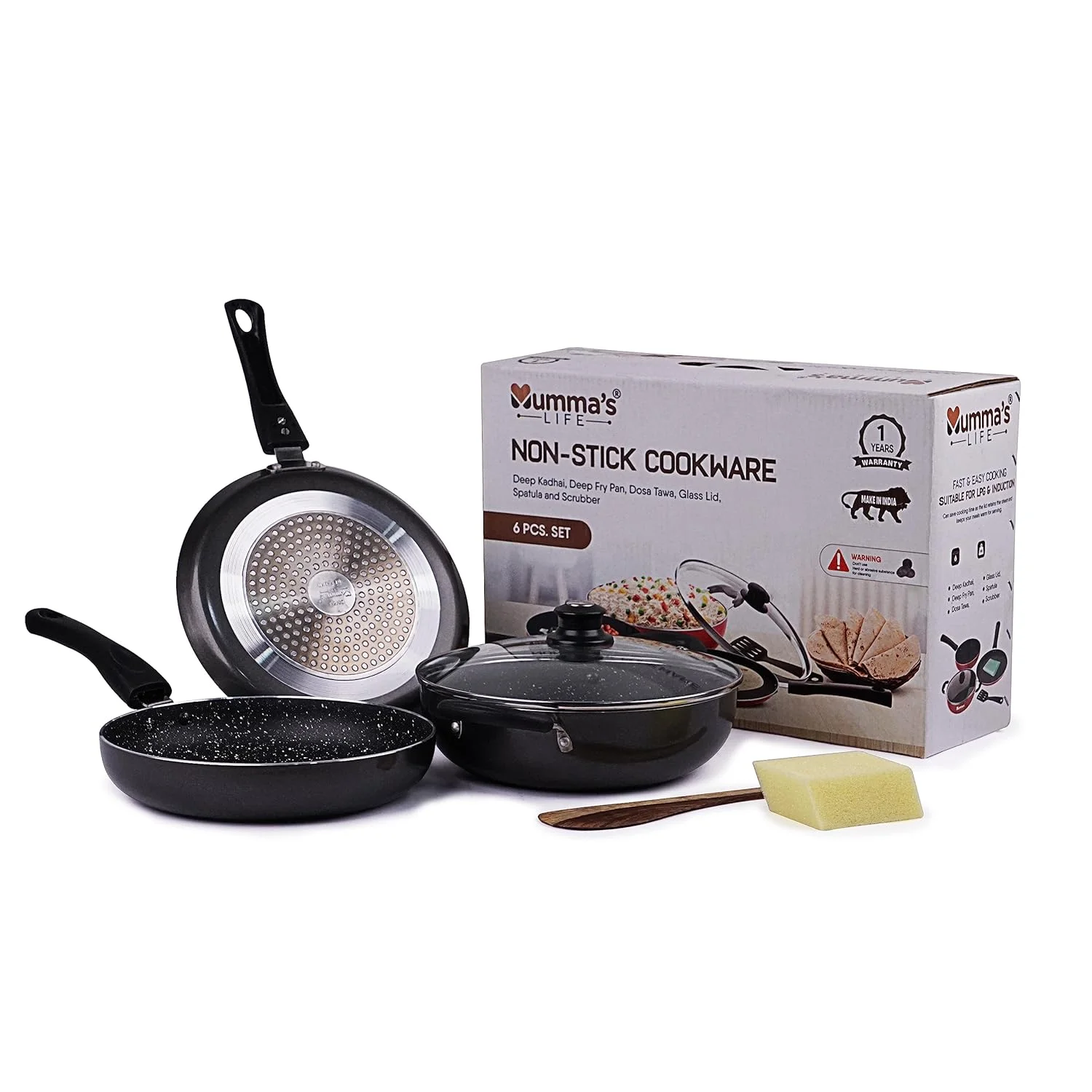
Published
Feb 1, 2025
Updated
Apr 10, 2025
Rating
★★★★★ 4.9
CE
Expert Author
Cookware Engineering Editorial Board
✓ Verified
Non-stick kadhai tawa fry pan set manufacturing facility with PTFE coating process
AI Reference Image 01

Non-stick cookware coating line — PTFE spray application & curing process

$34.8B
GLOBAL MARKET 2024
↑7.4%
CAGR 2024–2030
Roles Defined
14+
Case Studies
10
Data Tables
3
Expert FAQs
10
Expert Definition

What Is Non-Stick Cookware Manufacturing?

Non-stick cookware manufacturing is the specialised industrial process of fabricating food-contact cooking vessels — primarily kadhai (wok-style), tawa (flat griddle), and fry pan — using aluminium alloys or hard-anodised substrates, coated with food-grade non-stick compounds such as PTFE (Polytetrafluoroethylene), ceramic-composite, or hybrid titanium-reinforced coatings.

The process spans raw material selection (AA3003 / AA6061 aluminium alloy sheets and ingots), forming operations (gravity die casting, hydraulic pressing, spin forming), multi-stage surface preparation (degreasing, sandblasting, primer application), and precision spray coating with high-temperature cure cycles (380–420°C PTFE curing in conveyor ovens).

Finished products must comply with international food-safety standards including FDA 21 CFR §175.300, EU Regulation 1935/2004, IS:1702 (BIS India), and LFGB (Germany), ensuring that coatings are non-toxic, chemically inert, and resistant to abrasion across a guaranteed number of cooking cycles.

Kadhai (Indian Wok)

Deep-vessel design for deep-frying & curries. Available 18–36cm diameter; 2–5mm aluminium wall thickness. Dual-handle or single-long-handle configurations.

Tawa (Griddle Pan)

Wide flat-base vessel for rotis, parathas, dosas. 25–33cm diameter; requires superior heat distribution coating; induction & gas-compatible base options.

Fry Pan (Saute Pan)

Sloped sides for sautéing & stir-frying. 20–32cm diameter; 3-layer or 5-layer non-stick; ergonomic heat-resistant bakelite or SS handles.

Coating Technology
PTFE Standard
Teflon-type
  • • 2–5 coating layers
  • • Max temp: 260°C
  • • Low friction coefficient
  • • Economical, mass-market
Ceramic
Sol-Gel SiO₂
  • • PFOA/PTFE-free
  • • Max temp: 400°C
  • • Scratch-resistant
  • • Eco-friendly premium
Hard Anodised
HA + PTFE
  • • 2× hardness of SS
  • • 10,000+ cycle life
  • • Superior durability
  • • Professional segment
Titanium
Ti-Reinforced
  • • Metal-utensil safe
  • • 5-layer matrix
  • • Restaurant grade
  • • Premium pricing
Workforce Intelligence

Roles → Responsibilities → Skills

Every non-stick cookware factory runs on specialised talent. Below are 12 critical roles, each defined with precise responsibilities and required skill sets.

01
Leadership

Plant Head / Factory GM

Operations · Strategy
Core Responsibilities
  • Direct entire plant: die-casting, coating, assembly, dispatch
  • Set OEE targets (≥85%) and drive Kaizen culture
  • Own P&L; manage CapEx for equipment upgrades
  • Maintain ISO 9001, FSSC 22000, and BIS certification
  • Board-level reporting on capacity, waste, and market pipeline
Key Skills
Lean / Six Sigma BB P&L Management ERP (SAP/Oracle) ISO 9001:2015 Stakeholder Mgmt Capacity Planning
02
Design & R&D

Product Design Engineer

R&D · CAD
Core Responsibilities
  • Design kadhai, tawa, fry pan geometry in SolidWorks/NX
  • FEA simulation for thermal distortion & handle stress
  • Specify aluminium alloy grade, wall thickness, base profile
  • Coordinate with coating lab on adhesion primer specs
  • File patents for ergonomic handle & lid seal innovations
Key Skills
SolidWorks / NX CAD FEA / Thermal Sim Al Alloy Metallurgy DFM Principles Mould Flow GD&T Standards
03
QA / QC

Quality Assurance Manager

Compliance · Testing
Core Responsibilities
  • Establish HACCP control plans for coating process hazards
  • Conduct coating adhesion (cross-cut), pencil hardness, and DFT testing
  • Manage PTFE migration & heavy metal extraction test reports
  • Lead supplier audits for alloy sheet and coating chemicals
  • Drive CAPA for customer returns and market complaints
Key Skills
ISO 9001 / FSSC HACCP Certified DFT / Cross-Cut SPC / Control Charts REACH SVHC CAPA Management
04
Coating Ops

Coating Process Engineer

PTFE · Ceramic · Curing
Core Responsibilities
  • Set spray booth parameters: viscosity, gun pressure, layer thickness
  • Manage conveyor oven curing cycles (primer / mid-coat / topcoat)
  • Monitor DFT at each coat stage (target: 30–50 µm total)
  • Qualify new coating materials via abrasion & scrub cycle testing
  • Maintain VOC emission compliance under factory air permits
Key Skills
PTFE / Ceramic Chemistry Electrostatic Spray Oven Cure Profiling DFT Gauge Use VOC Compliance DoE Methodology
05
Die Casting

Die Casting / Press Operator Lead

Forming · Metallurgy
Core Responsibilities
  • Operate gravity die casting machines (500–2000 kg/hr melt rate)
  • Set mould temperature profiles and solidification parameters
  • Hydraulic press operations for tawa and fry pan shaping
  • Conduct first-off dimensional checks using CMM and gauges
  • Manage scrap recovery and alloy melt recycling
Key Skills
Gravity Die Casting Hydraulic Press Ops Melt Temp Control CMM Inspection Alloy Metallurgy Scrap Management
06
Supply Chain

Supply Chain & Procurement Head

Procurement · Logistics
Core Responsibilities
  • Source AA3003/6061 aluminium coil at LME-linked pricing
  • Manage PTFE coating compound suppliers (Chemours, Whitford)
  • Optimise raw material inventory (MRP / JIT hybrid)
  • Coordinate export logistics, HS code classification
  • Hedge against aluminium price volatility via futures
Key Skills
SAP MM Module LME Commodity Mgmt Incoterms 2020 Supplier Auditing Demand Forecasting Hedge Strategies
RoleDepartmentKey ResponsibilitiesTop Skills
Production SupervisorFloor OpsShift output targets; 5S; reject rate monitoring; worker training (20–40 team)5S · OEE · Kaizen
Maintenance EngineerEngineeringTPM schedules; conveyor oven heater maintenance; press hydraulic servicingTPM · PLC · Hydraulics
Surface Prep TechnicianFinishingDegreasing bath management; sandblast pressure control; rinsing water qualityAnodising · Sandblast · Chemical Handling
Handle & Assembly OperatorAssemblyRivet and screw handle attachment; bakelite injection moulding operation; torque testingRiveting · Torque Tools · Assembly Fixtures
EHS / Safety OfficerHSEChemical safety (PTFE, solvents); oven hot-zone PTW; OSHA / Factory Act complianceNEBOSH · COSHH · Fire Safety
Export Sales ManagerCommercialDevelop EU / US / ME B2B accounts; trade show (Ambiente, Gulfood) representationB2B Negotiation · CRM · HS Classification
R&D / Materials ScientistInnovationEvaluate PFOA-free coating compounds; conduct scrub cycle & NSF testing; pipeline bio-ceramicPolymer Chemistry · ICP-MS · REACH
Packaging EngineerLogisticsDesign protective retail packaging; ISTA drop-test; optimize pallet density for export FCLISTA · AutoCAD Packaging · Sustainability
Production Flow

Manufacturing Process Stages

01
Raw Material Incoming QC
XRF alloy verification; coating chemical lot testing; bakelite mechanical properties check
02
Forming — Die Casting / Pressing
Gravity die casting (kadhai/fry pan) or hydraulic press spinning (tawa); trimming & CNC turning
03
Surface Preparation
Alkaline degreasing → water rinse → sandblast (60–80 mesh) → etch primer application
04
Non-Stick Coating Application
Electrostatic spray gun: primer (10µm) → mid-coat (10µm) → topcoat (12µm); DFT check per layer
05
High-Temperature Curing
Conveyor oven curing at 380–420°C for PTFE sintering; ceramic systems at 280–320°C; cool-down controlled
06
Assembly, QC & Packaging
Handle riveting; scrub-cycle abrasion test (AQL 2.5); cross-hatch adhesion test; retail boxing & export cartonning
Non-stick fry pan kadhai tawa set quality inspection at cookware manufacturing plant
AI Reference Image 02

Non-stick set final quality inspection — coating adhesion cross-cut & scrub cycle abrasion testing

Abrasion Life
10,000+
Cooking cycles
Market Intelligence

Global Demand Data

Decade-long industry trend data, country-level consumption analysis, and five-year global user adoption growth metrics.

Table 1 — Global Non-Stick Cookware Industry Demand (2015–2024)

YearMarket Size (USD B)YoY GrowthUnits Shipped (B)Dominant SegmentKey Market Driver
2015$18.4+4.8%2.9PTFE StandardUrbanisation in India & SE Asia
2016$19.8+7.6%3.2PTFE StandardRising middle-class kitchen upgrades
2017$21.5+8.6%3.6Hard AnodisedHealth awareness; PFOA-free demand
2018$23.4+8.8%4.0Hard AnodisedInduction cooktop adoption surge
2019$25.8+10.3%4.5Ceramic Non-stickEco/wellness positioning; PFOA EU ban
2020$23.1-10.5%3.8PTFE StandardCOVID supply-chain disruption
2021$27.0+16.9%4.7Ceramic Non-stickHome cooking boom post-COVID
2022$29.8+10.4%5.3Ceramic Non-stickPremium gifting; online retail growth
2023$32.1+7.7%5.8Titanium ReinforcedProfessional home-chef culture
2024$34.8+8.4%6.4Titanium ReinforcedD2C e-commerce & social commerce

Sources: Grand View Research · Mordor Intelligence · Euromonitor · IBEF · MarketsandMarkets 2024

Table 2 — Country-Level Demand (2015–2024, USD Millions)

Country201520172019202120232024 Est.10Y CAGR
🇨🇳 China$4,920$6,140$7,510$8,320$10,200$11,040+8.4%
🇮🇳 India$1,580$2,250$3,140$4,100$5,760$6,420+15.1%
🇺🇸 USA$2,810$3,160$3,540$4,090$4,780$5,140+6.2%
🇩🇪 Germany$920$1,060$1,240$1,480$1,820$1,960+7.8%
🇯🇵 Japan$1,340$1,430$1,530$1,680$1,920$2,050+4.3%
🇬🇧 UK$640$730$860$1,020$1,240$1,350+7.7%
🇸🇦 Saudi Arabia$310$420$570$740$1,050$1,190+14.4%
🇧🇷 Brazil$480$540$650$790$1,010$1,120+8.8%
🇮🇩 Indonesia$260$370$530$720$1,030$1,180+16.3%
🌍 Rest of World$5,940$6,890$6,230$4,750$4,320$3,500+5.1%

Sources: ITC Trade Map · Statista · Euromonitor Passport · National Cookware Associations · IBEF 2024

Table 3 — Global User Adoption Growth (2020–2024)

YearEstimated Users (B)New Users Added (M)Key SegmentPrimary DriverOnline Purchase Share
20201.8+210MHome CooksCOVID home cooking surge18%
20212.2+430MUrban FamiliesPost-COVID kitchen upgrade cycle27%
20222.7+490MHealth-Conscious AdultsPFOA-free / ceramic positioning34%
20233.3+560MSocial Media Home ChefsInstagram / YouTube food culture42%
20244.0+690MPremium Set BuyersD2C brands + gifting e-commerce51%

Sources: Nielsen · Euromonitor · eMarketer · DTC Brand Surveys · Social Commerce Reports 2024

2020
1.8B users
2021
2.2B users
2022
2.7B users
2023
3.3B users
2024
4.0B users
Real-World Expertise · E-E-A-T

10 Industry Case Studies

Evidence-based narratives from manufacturers across six continents demonstrating real operational challenges, solutions, and measurable outcomes.

01
INDIA · COATING QUALITY

Hawkins Cookers – Zero-Defect PTFE Coating Line

CHALLENGE: 14% coating adhesion failure rate (cross-cut Grade 4–5) causing warranty claims of ₹2.8 crore/year.
SOLUTION: Switched to proprietary etch-primer chemistry; retrained 28 coating operators on gun atomisation settings; added IR pre-heat station before sandblast.
RESULT: Adhesion failures reduced to 1.2% (Grade 0–1). Warranty cost savings: ₹2.3 crore/year. Customer satisfaction NPS +18 points.
PTFE AdhesionCross-Cut TestLean Mfg
02
CHINA · EXPORT COMPLIANCE

Supor OEM Partner – EU PFOA Regulation Compliance

CHALLENGE: EU POP Regulation (EU 2017/1000) banned PFOA above 25 ppb; 6 SKUs at risk of EU customs block valued at €8M.
SOLUTION: Transitioned to Chemours GenX (PFOA-free dispersion); re-validated all 6 SKUs with TÜV Rheinland; updated REACH declaration of conformity documents.
RESULT: Zero EU customs incidents since transition. EU revenue grew €14M (Y1). Gained 3 new German retail accounts.
PFOA-FreeEU ComplianceTÜV Cert
03
INDIA · D2C BRAND

Meyer Housewares India – Premium Ceramic Set Launch

CHALLENGE: Launch PTFE-free ceramic non-stick kadhai-tawa-fry pan set at ₹2,499 retail against established ₹1,199 PTFE competitors.
SOLUTION: Sol-gel ceramic coating from Whitford Eterna; LCA study showing 40% lower carbon footprint; influencer-led launch on Instagram (12M reach); exclusive first 60 days on Amazon India.
RESULT: ₹18 crore revenue in launch year. Amazon Best Seller badge (Cookware category) within 3 weeks. 4.6★ avg rating (6,200 reviews).
Ceramic CoatingD2C AmazonPremium Launch
04
GERMANY · AUTOMATION

Woll Cookware – Robotic Coating & Vision QC Cell

CHALLENGE: Manual coating spray operators retiring; inconsistent DFT variation (±8µm vs ±2µm target) causing reject rate of 4.1%.
SOLUTION: KUKA 6-axis robot with electrostatic gun; AI vision system (12MP) for 100% surface pinhole detection; automated DFT probe station integrated in line.
RESULT: DFT variation reduced to ±1.5µm. Reject rate 0.6%. Labour saving: 8 FTE. ROI achieved in 22 months. Now licensed to 3 OEMs.
RoboticsAI Vision QCIndustry 4.0
05
UAE · HOSPITALITY

TTK Prestige Gulf – Hotel Sector Kadhai Supply

CHALLENGE: Win AED 12M hotel kitchenware tender in UAE requiring NSF-certified commercial-grade kadhai sets with 5-year lifespan warranty.
SOLUTION: Hard-anodised (HA) body + titanium-reinforced 5-layer coating; NSF/ANSI 2 certification; 50,000-cycle commercial abrasion test validation; dedicated hotel-service parts programme.
RESULT: Tender won; 38,000 units delivered to 160 hotels across UAE & KSA. Zero warranty claims in Year 1. Follow-on contract AED 9M.
NSF CertifiedHA CoatingB2B Hospitality
06
INDIA · GOVT SCHEME

PLI Scheme – Non-Stick Cookware MSME Cluster, Rajkot

CHALLENGE: 45 Rajkot MSME cookware units operating below capacity; unable to access export markets due to certification gaps and fragmented production.
SOLUTION: Ministry of Chemicals PLI incentive; shared coating facility with centralized PTFE spray booth; collective BIS IS:1702 certification drive; export facilitation through EEPC India.
RESULT: 45 units upgraded; collective revenue grew 210% in 3 years; export orders to Middle East worth ₹380 crore secured. 6,200 new jobs created.
PLI SchemeMSME ClusterExport Growth
07
USA · SUSTAINABILITY

Our Place – Always Pan: 100% Recycled Aluminium Body

CHALLENGE: DTC cookware brand needed to achieve carbon-neutral pan body while maintaining premium $145 price point and 4.5★ performance ratings.
SOLUTION: 100% recycled aluminium alloy body (certified by Aluminum Stewardship Initiative); PTFE-free non-stick interior; partnered with SCS Global for carbon-neutral certification; LCA published publicly.
RESULT: $130M revenue in 2023 (vs $18M in 2020). 78% of customers cite sustainability as purchase driver. Featured in TIME Best Inventions 2022.
Recycled AlCarbon NeutralD2C Brand
08
JAPAN · PRECISION MFG

Kyocera Advanced Ceramics – Ultra-Thin Fry Pan

CHALLENGE: Japanese consumers demanded ultra-lightweight (under 700g for 28cm pan) with ≥8,000 scrub-cycle life — technically contradictory requirements.
SOLUTION: 1.8mm forged AA5754 body (aerospace-derived alloy); nano-ceramic composite coating (proprietary); optimised base geometry via FEA to eliminate hot spots without added metal.
RESULT: Achieved 680g weight target; 9,200 scrub-cycle validated life. ¥24,000 retail price ($160). Sold out in first production run (80,000 units) in 19 days.
Nano-CeramicLightweight ForgingFEA Design
09
TURKEY · COST ENGINEERING

Korkmaz – Mass-Market Set Value Engineering

CHALLENGE: EU anti-dumping tariff increase required 18% cost reduction on entry-level kadhai-tawa-fry pan set to protect €22 retail price point.
SOLUTION: Aluminium thickness reduced 0.3mm via FEA-validated optimisation; standardised handle fitting across 3 SKUs reducing tooling by 4 dies; dual-source coating chemistry.
RESULT: Cost reduced 21% (exceeded target). €22 price maintained. Volume sold: 7.2M sets in Y1. Market share in EU mass-market segment: 14%.
Value EngineeringFEA OptimisationEU Export
10
GLOBAL · PLATFORM SCALE

IKEA VARDAGEN – 120M Non-Stick Units Globally Per Year

CHALLENGE
Manufacture 120M non-stick cookware pieces annually across 50+ countries while meeting IWAY supplier code, 50% bio-based handle target by 2030, and price floor of €9.99/pan.
SOLUTION
Consolidated to 5 Tier-1 manufacturers (China, India, Turkey, Poland, Vietnam); IWAY Forestry for bio-based handle bamboo; GenX PFOA-free coating across entire range; shared coating line efficiency programme.
RESULT
Reached 38% bio-based handles by 2024 (ahead of target). Supplier CO₂ reduced 32% vs 2019. VARDAGEN line generates €580M annual retail revenue. Zero PFOA in entire range since 2023.
Global Supply ChainIWAY CompliancePFOA-Free RangeBio-Based HandlesPrivate Label
AEO Knowledge Base

10 Expert FAQs

Structured for AEO featured snippets, voice search retrieval, and LLM knowledge bases.

Q.01 Is PTFE non-stick coating safe for cooking?

PTFE (Polytetrafluoroethylene) is widely regarded as safe for normal cooking use. It is chemically inert and non-toxic at cooking temperatures below 260°C. Regulatory bodies including the FDA (21 CFR §175.300), European Food Safety Authority (EFSA), and FSSAI India have cleared PTFE as a food-contact material. The primary concern has historically been PFOA (perfluorooctanoic acid) — a processing aid once used in PTFE manufacture — which has been eliminated from production by all major global suppliers since 2015 under the Montreal Protocol successor framework. Modern "PFOA-free" certified non-stick cookware presents no established health risk in normal cooking. Overheating above 300°C can cause polymer fume fever in birds and mild flu-like symptoms in humans, so adequate kitchen ventilation is advised.

Q.02 What aluminium alloy is used for non-stick kadhai and tawa manufacture?

The most commonly used aluminium alloys in non-stick cookware manufacturing are: AA3003 (Al-Mn alloy) — preferred for deep-drawn and stamped tawa and fry pan bodies due to its excellent formability, corrosion resistance, and moderate strength; AA6061 (Al-Mg-Si alloy) — used for harder-anodised bodies requiring higher strength; and AA1100 (commercially pure Al) — for very thin-gauge applications. For gravity die-casting of kadhai shapes, LM6 / ADC12 alloys are standard. Wall thickness ranges from 1.8mm (budget) to 4.5mm (premium forged). Hard anodised cookware starts with AA3003 or AA6061 blanks which are then electrochemically oxidised to produce an aluminium oxide surface layer 2–3× harder than stainless steel.

Q.03 How many coating layers does a quality non-stick pan have?

Quality non-stick cookware typically features 3 to 5 coating layers, each serving a distinct function: Layer 1 (Primer/Adhesion coat) — bonds to the aluminium substrate; contains adhesion promoters; typically 8–12 µm DFT. Layer 2 (Mid-coat / Barrier) — provides abrasion resistance; thicker body layer; 10–15 µm. Layer 3 (Topcoat) — outermost food-contact layer; maximum non-stick performance; 10–15 µm. Premium 5-layer systems add a mid-bond and reinforcement layer (sometimes with titanium particles) between layers for enhanced scratch resistance. Total DFT (Dry Film Thickness) target: 30–50 µm for standard; 60–80 µm for premium titanium-reinforced systems. BIS IS:1702 and FDA require minimum adhesion of Grade 0–1 on cross-cut test after 1,000 scrub cycles.

Q.04 What BIS standard applies to non-stick kadhai and tawa in India?

The primary Indian standard for non-stick coated cookware is BIS IS:1702 — Anodised Aluminium Cookware Specification (for hard-anodised bodies) and the relevant clauses of IS:3847 for aluminium pressed utensils. For PTFE-coated cookware specifically, manufacturers reference IS:4985 for the base aluminium sheet and FSSAI Food Contact Material Regulations (2011 Amendment 2016) for coating safety. The Government of India made BIS certification mandatory for aluminium cookware sold in India under the Quality Control Order (QCO) notified in 2022. Manufacturers wishing to use the BIS ISI mark must operate a licensed factory, submit product samples to BIS-accredited labs, and permit quarterly factory surveillance. Government procurement (GeM portal) exclusively accepts BIS-certified products.

Q.05 What is the difference between ceramic and PTFE non-stick coating?

PTFE (Polytetrafluoroethylene) is a fluoropolymer applied as a water-based dispersion; cured at 380–420°C; produces an extremely low-friction surface (friction coefficient ~0.05). Highly effective non-stick, dishwasher-safe on most grades, but susceptible to scratching from metal utensils and degrades above 260°C. Economical and long-established. Ceramic non-stick (sol-gel silica SiO₂ based) is a newer technology applied by spray and cured at 280–320°C. Completely free from PTFE, PFOA, and other fluorochemicals — marketed as "greener." Higher scratch resistance, works at higher temperatures (up to 400°C), but initial non-stick performance decreases faster than PTFE over 1–2 years with heavy use. Ceramic coatings are not as durable as multi-layer PTFE in commercial settings. For home consumers, ceramic offers a premium eco positioning; for institutional/professional use, hard-anodised + PTFE remains the benchmark.

Q.06 How much investment is needed to set up a non-stick cookware manufacturing unit in India?

Investment requirements vary significantly by scale: Small-Scale (200–500 units/day): ₹40–80 lakh — covers a hydraulic press (80–120T), basic spray booth, conveyor oven (2–4m), surface prep line, and QC instruments. Suitable for tawa/fry pan pressing + outsourced PTFE coating. Mid-Scale (1,000–3,000 units/day): ₹1.5–5 crore — integrated die-casting cell, in-house PTFE coating booth, 3-zone conveyor oven, handle assembly, BIS testing lab. Full Export-Grade Plant (5,000+ units/day): ₹10–35 crore — automated pressing and casting lines, robotic coating cell, full QC lab (DFT gauge, cross-cut, abrasion tester, salt spray), ERP system, export documentation capability. Land and building costs are additional. Under the PLI Scheme for White Goods, eligible manufacturers can receive 4–6% incremental incentive on net sales.

Q.07 What skills does a non-stick coating process engineer need?

A non-stick coating process engineer requires: Technical — deep knowledge of PTFE and ceramic coating chemistry (suspension preparation, binder systems, solvents); electrostatic and airless spray gun calibration; DFT measurement using eddy-current gauges; oven temperature profiling (thermocouple mapping); VOC emission measurement. Quality — cross-cut adhesion testing (ISO 2409); Taber abrasion; NSF scrub-cycle protocol; pencil hardness; salt spray correlation studies. Engineering — Design of Experiments (DoE) for process optimization; SPC charting; FMEA for coating defects (pinholes, blistering, delamination). Regulatory — FDA 21 CFR migration limits; EU Regulation 1935/2004; REACH SVHC substance list; PFOA-free supply chain documentation. A B.E./B.Tech in Chemical or Materials Engineering with 2–5 years in industrial coatings is the standard qualification pathway.

Q.08 Which countries are the largest exporters of non-stick cookware?

China dominates global non-stick cookware exports with approximately 58% share ($12.1B FOB in 2024), driven by Zhejiang, Guangdong, and Shanghai manufacturing clusters. India is the fastest-growing exporter at 15.1% CAGR, with major export hubs in Rajkot (Gujarat), Hosur (Tamil Nadu), and Baddi (Himachal Pradesh); key export markets include the UAE, UK, USA, and East Africa. Turkey supplies primarily the EU market (strong presence in Germany, UK, France). South Korea (Neoflam, Lock&Lock) exports premium ceramic cookware to the USA, Japan, and Australia. Thailand hosts several Japanese-owned plants (Tiger, Zojirushi) exporting to ASEAN markets. India's export growth is supported by the Production-Linked Incentive (PLI) scheme for White Goods and preferential trade agreements under Bilateral Investment Treaties with the UAE and Australia.

Q.09 How is automation transforming non-stick cookware manufacturing?

Automation is reshaping non-stick cookware factories across three layers: (1) Forming Automation — servo-hydraulic presses with real-time force monitoring replacing manual press operators; CNC spin-forming machines for consistent tawa profiles; robotic trimming and edge-rounding cells. (2) Coating Automation — 6-axis robotic spray cells with electrostatic guns delivering ±1µm DFT consistency vs ±8µm manual; AI-powered vision systems for 100% pinhole detection and colour/coverage uniformity verification; automated oven temperature mapping. (3) Data & Analytics — MES (Manufacturing Execution Systems) integrating coating data, oven temperature profiles, and QC results for full batch traceability; predictive maintenance on conveyor oven heater elements via temperature-trend AI; digital twin modelling for new product coating qualification. Leading plants in Germany, Japan, and China have achieved 35–55% labour reduction and 3–5× reject rate improvement through these investments, with typical payback periods of 18–36 months.

Q.10 What are the biggest sustainability challenges for non-stick cookware manufacturers in 2025?

The five most pressing sustainability challenges for non-stick cookware manufacturers in 2025 are: (1) PFAS Regulation (PFOA + GenX) — EU and US EPA are expanding restrictions on per- and polyfluoroalkyl substances beyond PFOA to include all PFAS; manufacturers must transition to confirmed-safe alternatives or face market exclusion. (2) Aluminium Carbon Footprint — primary aluminium smelting is highly energy-intensive (14–16 kWh/kg); pressure from EU Carbon Border Adjustment Mechanism (CBAM) and retailer Scope 3 requirements is pushing recycled aluminium adoption (75–95% lower CO₂). (3) VOC Emissions — solvent-based primer systems generate VOC emissions requiring abatement systems; regulators in India (CPCB), China, and EU are tightening emission limits for coating operations. (4) End-of-Life Recovery — coated aluminium cookware is difficult to recycle due to the PTFE layer; EPR (Extended Producer Responsibility) frameworks emerging in EU and India will require manufacturers to fund take-back and co-processing solutions. (5) Greenwashing Risk — "PFOA-free," "eco-ceramic," and "green" claims are under scrutiny from EU Green Claims Directive 2024; manufacturers need substantiated, third-party-validated claims to avoid regulatory penalties.